
By Shelton Muchena
Lead Investigative Correspondent in England
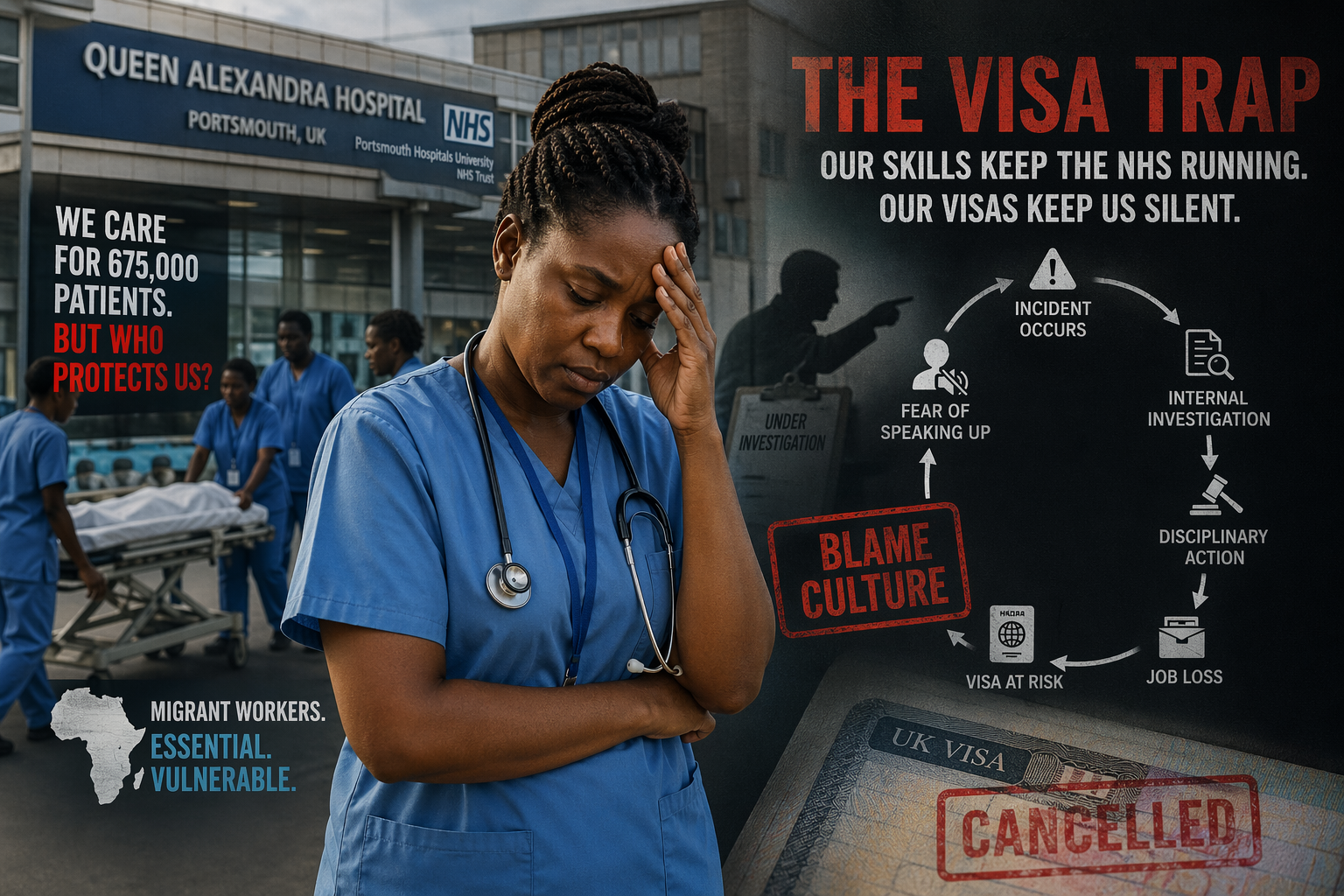
PORTSMOUTH, UK: Queen Alexandra Hospital, a major facility operated by Portsmouth Hospitals University NHS Trust, relies heavily on migrant healthcare workers, particularly from African countries, to support services for its estimated 675,000 patients.
The Trust, which employs around 8,700 staff and holds a “Good” rating from Care Quality Commission, has recently announced reforms aimed at improving the handling of staff concerns. Chief People Officer Kelvin Cheatle stated that the measures are intended to reduce delays and strengthen oversight in internal investigations.
However, concerns have been raised about the impact of these processes on migrant workers employed under visa sponsorship. Unlike UK-based staff, migrant employees may face immigration consequences if disciplinary actions affect their employment status. For these workers, internal investigations can carry the risk of job loss and potential visa cancellation, highlighting ongoing concerns about workplace vulnerability within the National Health Service.
Investigation has found that the “consistency” promised by the Trust often fails to account for the “Visa Trap” a systemic reality where the power dynamic between employer and employee is fundamentally broken. In the high-pressure wards of the Queen Alexandra, African professionals often find themselves on the most grueling shifts, filling the gaps in a system that would collapse without them. Yet, they remain the most vulnerable to a “blame culture” that has shifted from the overt to the institutional. When a patient incident occurs, the migrant worker is statistically more likely to find themselves in the crosshairs of a formal inquiry. For them, “speaking up” is not an act of freedom; it is a gamble with their right to remain in the country.
The evidence is etched in the silent anxiety of the hospital’s breakrooms. Despite the Trust’s introduction of an independent “Freedom to Speak Up” service, the psychological barrier for African staff remains nearly insurmountable. They are the “Human Export” of nations like Zimbabwe and Nigeria highly trained, deeply experienced, and yet treated as temporary commodities. They carry the weight of entire families back home on their shoulders, sending remittances that keep distant economies afloat. To be “investigated” is to risk the education of siblings, the healthcare of parents, and the stability of a future built on the promise of the West.
As the Trust boasts of “clear expectations of acceptable behaviors,” it ignores the cultural nuances that often lead to the marginalisation of international staff. Assertiveness is often misread as aggression; cultural reserve is often mistaken for a lack of competence. This investigative analysis suggests that the “Good” rating afforded to such institutions may be built on a foundation of silent compliance. The NHS is not just facing a staffing crisis; it is facing a moral one. It is an organisation that relies on the brilliance of the Global South while maintaining a disciplinary architecture that keeps those same professionals in a state of perpetual precariousness.
The British healthcare system depends heavily on talent drawn from across Africa. At places like Queen Alexandra Hospital, migrant workers keep services running day and night. The real question is whether the system protects them in return. If promises of fairness and oversight do not translate into dignity and proper treatment, then the NHS is not only healing patients, it is exploiting the very people it relies on. This is a clear case of global recruitment without equal respect, where skilled professionals are brought in to fill gaps but are not always valued as they should be.