
By Desmond Nleya
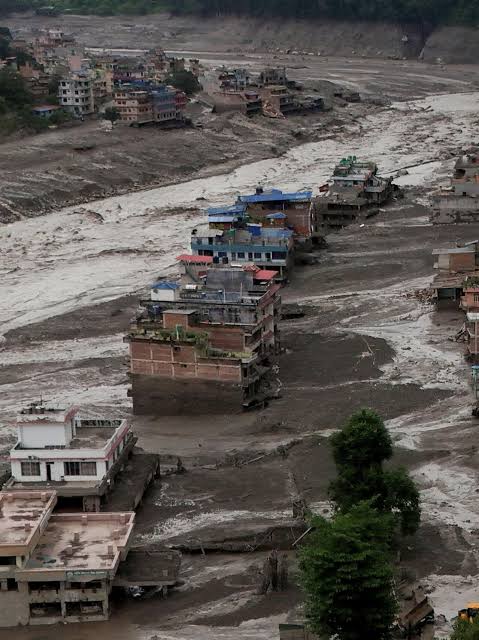
At least 165 people have died and nearly 1,500 others are missing after a catastrophic flash flood swept through mountainous areas along the Nepal-Tibet border, destroying villages, roads and infrastructure and leaving rescuers racing against time to find survivors.
The disaster struck on Wednesday in a region popular with tourists, trekkers and religious pilgrims. Authorities said the majority of those missing are tourists, including hundreds of foreign nationals from India, the United States, Australia, Britain and Canada.
Nepali police said 165 bodies had been recovered by late Wednesday, while Chinese state media reported three deaths on the Tibet side of the border.
In Nepal, officials said 826 people were still unaccounted for, including almost 600 foreigners. Those reported missing included 177 Indians, 63 Americans, 34 Australians, 33 Britons and 25 Canadians.
On the Tibet side, Chinese state media reported that 558 people were missing, including at least 260 foreign nationals.
The powerful torrent swept through valleys, carrying mud, rocks and debris and destroying homes, vehicles, roads and hydroelectric infrastructure. Entire populated areas were reportedly inundated or buried under mud.
Many of those caught in the disaster were travelling to Kailash Mansarovar, a high-altitude pilgrimage site in Tibet considered sacred by Hindus and Buddhists.
Initial reports suggested that an earthquake may have triggered the disaster after a section of glacier collapsed. However, the US Geological Survey later determined that the seismic shock initially recorded as a 4.4-magnitude earthquake was actually caused by the collapse of glacial rock and ice and the movement of debris.
An initial analysis of satellite imagery indicated that a landslide involving ice and rock triggered a debris-filled flood in the Lhende River, approximately 20 kilometres north-east of the Rasuwagadhi border crossing between Nepal and China.
Rescue teams have been working in extremely difficult mountainous terrain, with helicopters deployed to evacuate survivors and search for missing people. Nepalese security forces have also deployed sniffer dogs as rescuers comb through areas buried by mud and debris.
Survivors described terrifying scenes as the wall of water and mud swept through the region with little warning.
One survivor, Bibek Kumal, said he was carried downstream by the torrent but managed to survive after clinging to a mango tree. Another survivor, 68-year-old Keshav Prasad Baral, said he watched helplessly as his wife was swept away by the mud.
The International Federation of Red Cross and Red Crescent Societies said entire villages and market areas had been wiped out by the disaster.
China has deployed nearly 800 emergency workers, 150 vehicles, sniffer dogs and boats to support rescue operations on the Tibet side. Chinese President Xi Jinping called for authorities to make every effort to locate and rescue those still missing.
The United Nations has also begun mobilising supplies and personnel to support communities affected by the disaster, while the United States announced $500,000 in emergency assistance.
The scale of the disaster has also created an international search for missing tourists. Tour operator Himalayan Glacier said 47 people from one of its groups were missing, including Australians, Canadians, Americans, Britons, Singaporeans and a Russian-American dual national.
With communications disrupted and electricity cut off in several affected communities, families have gathered at rescue bases seeking information about relatives whose whereabouts remain unknown.
Rescue operations are expected to continue as authorities assess the full extent of the destruction and search for hundreds of people feared trapped beneath mud and debris.