
By Staff Reporter
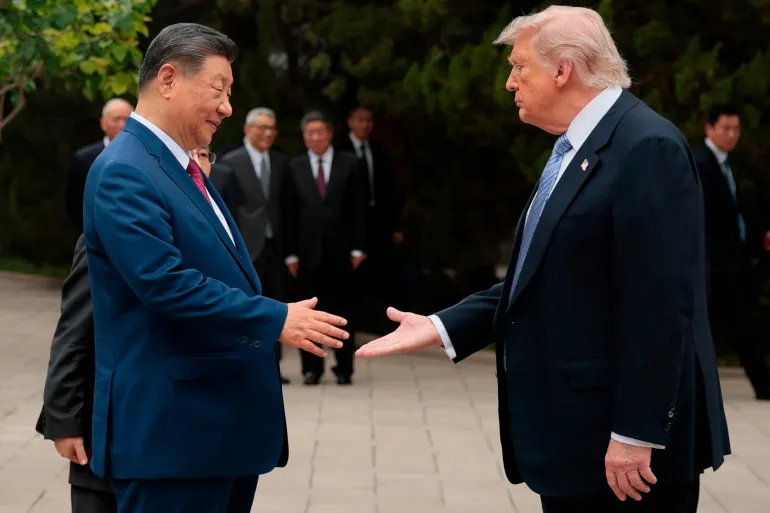
The growing technological rivalry between the United States and China is turning artificial intelligence into a major battleground for economic and geopolitical influence.
Washington has increasingly used export controls, restrictions on advanced semiconductors and supply-chain partnerships to slow China’s access to cutting-edge AI technology. Beijing, meanwhile, is investing heavily in domestic chips, AI research and alternative supply chains.
But the emerging contest is more complicated than a simple race between two superpowers.
The biggest question may not be which country eventually dominates artificial intelligence, but whether attempts to contain a rival will fragment the global technology industry.
AI competition is no longer just about chips
Advanced semiconductors remain central to the development of powerful AI systems, giving the US and its allies considerable leverage over China.
China continues to face restrictions on access to some advanced chips, chip-design software and semiconductor manufacturing equipment. These measures can increase costs and make it more difficult for Chinese companies to obtain the latest technology.
However, AI development involves far more than access to the newest processors.
Researchers, engineers, investment, computing efficiency, software development, market size and the ability of businesses to adopt new technology all play important roles.
China has responded to restrictions by accelerating efforts to develop domestic alternatives while also improving the efficiency of its AI models and making greater use of the computing resources already available to it.
This means export controls may slow China’s progress without necessarily stopping it.
The danger of creating two technology worlds
One of the biggest consequences of the rivalry could be the emergence of separate technology ecosystems.
The US and its partners are strengthening supply chains designed to reduce dependence on China. Beijing is simultaneously seeking greater technological self-reliance.
Such a division could affect everything from semiconductors and cloud computing to AI models, telecommunications and advanced manufacturing.
For technology companies, however, global markets remain important.
Nvidia CEO Jensen Huang has publicly criticised US restrictions on chip exports to China, arguing that the measures have cost American companies significant business. Meanwhile, some US startups have opposed proposals to restrict access to Chinese open-source AI models, warning that excessive restrictions could reduce competition and increase the influence of the largest American technology companies.
These concerns highlight an important dilemma for Washington: measures designed to weaken China’s technology sector can also create costs for American companies.
Allies could become increasingly important
The United States cannot control the entire semiconductor supply chain by itself.
Advanced chips depend on a complex international network involving American technology, semiconductor manufacturing in Taiwan, equipment from companies in the Netherlands and Japan, and other suppliers around the world.
This gives US allies an important role in determining how far restrictions can go.
If governments and companies conclude that prolonged restrictions are damaging their own commercial interests, pressure could grow for alternative supply chains.
That would create an unintended consequence: instead of permanently keeping China behind, aggressive restrictions could encourage Beijing to accelerate its efforts to develop independent technologies.
China has leverage of its own
The technological relationship between Washington and Beijing is not one-sided.
China occupies a powerful position in the global rare-earth supply chain. Rare earth elements are important in numerous high-tech industries, including electronics, renewable-energy technologies and defence systems.
China’s dominance in mining, processing and refining gives Beijing a potential source of leverage during periods of heightened economic tension.
Reducing dependence on China will therefore require more than simply finding alternative sources of raw materials. Other countries would need to develop mining, processing expertise and industrial capacity capable of competing with China’s established supply chain.
That process could take years and require significant investment.
The global economy could pay the price
The US-China AI competition is therefore creating a difficult balancing act.
Washington wants to protect national security and maintain its technological advantage. Beijing wants to reduce its dependence on Western technology and build a more self-sufficient technology sector.
Both objectives are understandable from the perspective of national strategy.
But if competition develops into widespread technological separation, businesses and consumers around the world could face higher costs, duplicated supply chains and fewer opportunities for international cooperation.
There is also a risk that smaller countries will be pressured to choose between competing technology ecosystems.
Cooperation may become harder — but more necessary
The US-China AI rivalry is unlikely to disappear soon. Artificial intelligence has become too important to national security, economic growth and technological development for either side to simply step away.
The challenge will be preventing competition from turning into complete technological isolation.
Competition can encourage innovation. But an AI world divided into rival technological blocs could also reduce collaboration, increase costs and make the global technology system less efficient.
The future of artificial intelligence may therefore depend not only on who develops the most powerful models or manufactures the most advanced chips, but on whether the world’s major powers can compete without completely dismantling the technological connections that have made the AI revolution possible.
The US-China AI contest is already changing the global technology landscape. The question now is whether that competition produces faster innovation — or a more divided and expensive digital world.