
By Desmond Nleya
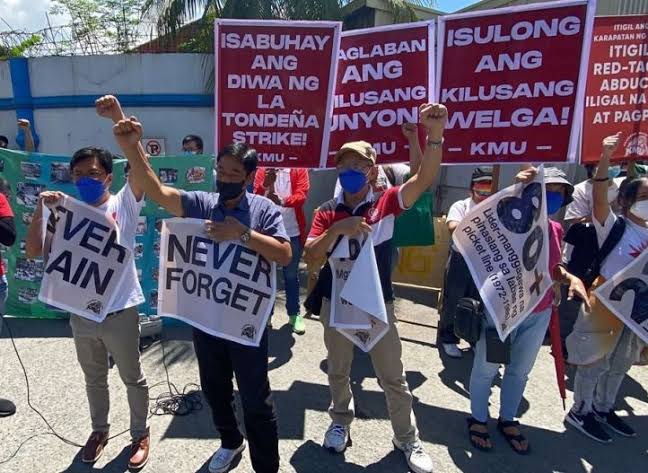
MANILA — Thousands of protesters gathered in Manila and other parts of the Philippines on Monday as the country marked the 54th anniversary of former President Ferdinand Marcos Sr.’s declaration of martial law.
The demonstrations, which brought together various political, youth, student, religious and civil society groups, were also driven by concerns over alleged corruption, political dynasties, rising living costs, wages and civil liberties.
The largest gatherings were reported in Manila, where protesters marched along Taft Avenue towards Liwasang Bonifacio before a planned procession to Mendiola near the presidential palace.
Authorities imposed tight security measures around Malacañang, with barriers installed near Mendiola and access roads to the presidential complex restricted.
The Manila city government also suspended face-to-face classes at all levels on Monday following a police recommendation, citing security, traffic and access concerns around the protest areas.
Protests spread across the country
Demonstrations were also planned in several cities and provinces, including Baguio, Abra, Legazpi, Calamba, Santa Rosa, Bacoor, Lucena, Iloilo, Bacolod, Tacloban, Roxas, Kalibo and Davao.
Police in the Calabarzon region were placed on full alert as authorities prepared for the nationwide protests.
The Bagong Alyansang Makabayan (Bayan) said its demonstrations were focused partly on demands for accountability over alleged corruption, including controversies surrounding flood-control projects.
The organisation has also raised concerns over political dynasties, stagnant wages amid rising prices and what it describes as restrictions on civil rights.
Marcos administration faces criticism
Some protesters have also criticised President Ferdinand Marcos Jr.’s support for the US-led Pax Silica initiative, with Bayan arguing that the policy reflects excessive US influence.
Other participating groups are expected to raise separate concerns, making Monday’s demonstrations a broad collection of protests rather than a single-issue movement.
Youth and student organisations held separate demonstrations in Metro Manila over the weekend, calling for greater government transparency, accountability over corruption and action on political dynasties.
A University of the Philippines student protest was also held in Diliman on September 18, with participants raising concerns about corruption and Pax Silica.
More than 17,000 police deployed
More than 17,000 police officers have been deployed across the Philippines to provide security during the demonstrations, including more than 15,000 in Metro Manila.
The presidential complex has closed the New Executive Building and Presidential Action Center as a security precaution.
The Philippine National Police said officers had been instructed to respect the constitutional rights to freedom of speech and peaceful assembly while maintaining public safety.
Police Chief General Jose Melencio Nartatez Jr. said officers would observe maximum tolerance but warned that violence, destruction of property and attacks on police would result in intervention under the law.
Police personnel have also been instructed to use body-worn cameras and properly document their operations.
Why September 21 is significant
September 21 marks the date in 1972 when Marcos Sr. signed Proclamation No. 1081, placing the Philippines under martial law.
The proclamation cited armed rebellion, communist insurgency, separatism, violence and threats to public order.
Security forces began making arrests the following day, while Marcos publicly announced martial law in a televised address on September 23.
The period that followed was marked by widespread arrests, detention, torture, censorship and restrictions on civil liberties. Martial law was formally lifted in January 1981, although Marcos remained president until he was removed from power during the 1986 People Power Revolution.
Government calls for peaceful demonstrations
The Marcos administration has said it respects the right of Filipinos to express their grievances and stage peaceful demonstrations.
Presidential Communications Office Undersecretary Claire Castro said the government remained open to hearing public concerns while stressing that demonstrations should remain peaceful.
The rallies bring together organisations with different political positions and priorities. While many share demands for accountability, their views differ on government policy, US relations and the country’s political system.
For authorities, the immediate challenge is maintaining public safety while allowing peaceful assembly.
For protest organisers, the demonstrations provide an opportunity to press their demands for accountability over both historical issues and current government policies.
The September 21 anniversary has therefore become an annual focal point for groups opposing authoritarian rule and criticising the Marcos family, while this year’s demonstrations have added contemporary concerns over corruption, the economy, civil liberties and foreign policy.