
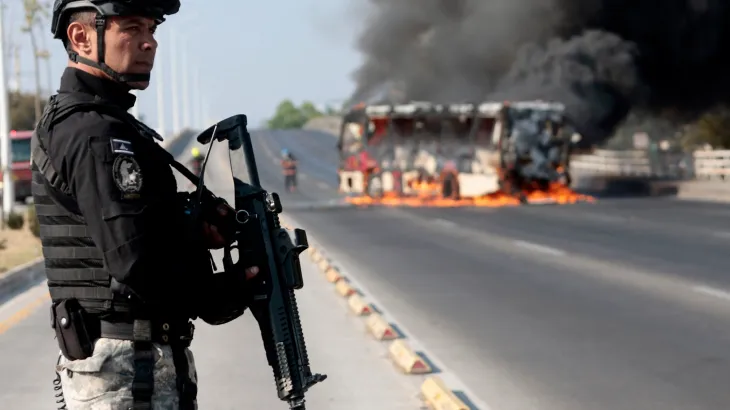
Guadalajara, Mexico — February 22, 2026
Violence swept across western Mexico after security forces killed Nemesio Ruben Oseguera Cervantes, better known as El Mencho, the powerful leader of the Jalisco New Generation Cartel (CJNG).
Authorities said Oseguera, 59, was wounded during a military clash in Tapalpa, Jalisco state, and died while being airlifted to Mexico City. His death triggered coordinated retaliatory attacks across at least six states, with cartel gunmen torching vehicles, blocking highways and spreading fear in major urban centres.
The United States had placed a $15 million bounty on Oseguera’s head.
Highways Blocked, Cities Paralyzed
Within hours of the operation, burning buses and trucks were reported in Jalisco, Colima, Michoacán, Nayarit, Guanajuato and Tamaulipas. Armed groups erected roadblocks and set vehicles ablaze, paralyzing transport routes.
Guadalajara — one of Mexico’s largest cities and a host venue for the upcoming FIFA World Cup — was reduced to near standstill. Residents sheltered indoors as public transport was suspended and schools cancelled classes.
Videos circulated online showed panicked passengers running through Guadalajara International Airport while smoke billowed over Puerto Vallarta, a popular Pacific coast tourist destination.
Jalisco Governor Pablo Lemus urged residents to remain at home, describing the situation as tense but under control.
Mexican President Claudia Sheinbaum praised security forces for the operation and called for calm.
“There is absolute coordination with the governments of all states,” she wrote on social media. “In the vast majority of the national territory, activities are proceeding with complete normality.”
A Major Cartel Leader Falls
Oseguera’s death marks one of the most significant blows to organised crime since the capture of Joaquin Guzman and Ismael Zambada, founders of the Sinaloa cartel, both now in US custody.
The Mexican Defence Secretariat confirmed the raid was carried out with intelligence support from US authorities. Four cartel members were killed during the operation, two more died during transfer, and two suspects were arrested. Security forces seized rocket launchers, armoured vehicles and heavy weapons. Three soldiers were wounded.
US Deputy Secretary of State Christopher Landau described Oseguera as “one of the bloodiest and most ruthless drug kingpins,” calling the operation “a great development for Mexico, the US, Latin America, and the world.”
Travel Warnings and Flight Suspensions
The US State Department issued travel warnings for several Mexican states, urging Americans to shelter in place. Canada followed with similar advisories, particularly for Puerto Vallarta.
Airlines including Air Canada, United Airlines and American Airlines suspended flights to Puerto Vallarta and Guadalajara amid security concerns.
Power Vacuum and Risk of Civil War
Security analysts warn that Oseguera’s killing could ignite internal conflict within the CJNG.
His brother, son (El Menchito) and daughter are all imprisoned, leaving no clear successor. Experts fear regional commanders could begin fighting for control, similar to the violent factional war that erupted within the Sinaloa cartel after El Chapo’s arrest.
John Holman of Al Jazeera described Oseguera as “the most powerful Mexican drug trafficking figure that was free in the country,” warning that today’s victory could evolve into a broader security crisis.
The timing is particularly sensitive, as Mexico prepares to co-host the 2026 FIFA World Cup, with Guadalajara among the host cities.
Structural Problems Remain
Former US Drug Enforcement Administration official Mike Vigil cautioned that removing a cartel leader rarely dismantles the organisation itself.
“They have to go after the infrastructure, logistics, money laundering, and armed wings — and they have to do it quickly,” he said.
Vigil also criticised Washington for failing to address US-based demand and the steady flow of firearms southbound into Mexico.
Hundreds of thousands of weapons reportedly enter Mexico from the United States each year, fueling cartel violence, while US domestic drug demand continues to drive trafficking operations.
“If there is no demand, there’s not going to be any cartels,” Vigil said. “It’s a big problem.”