
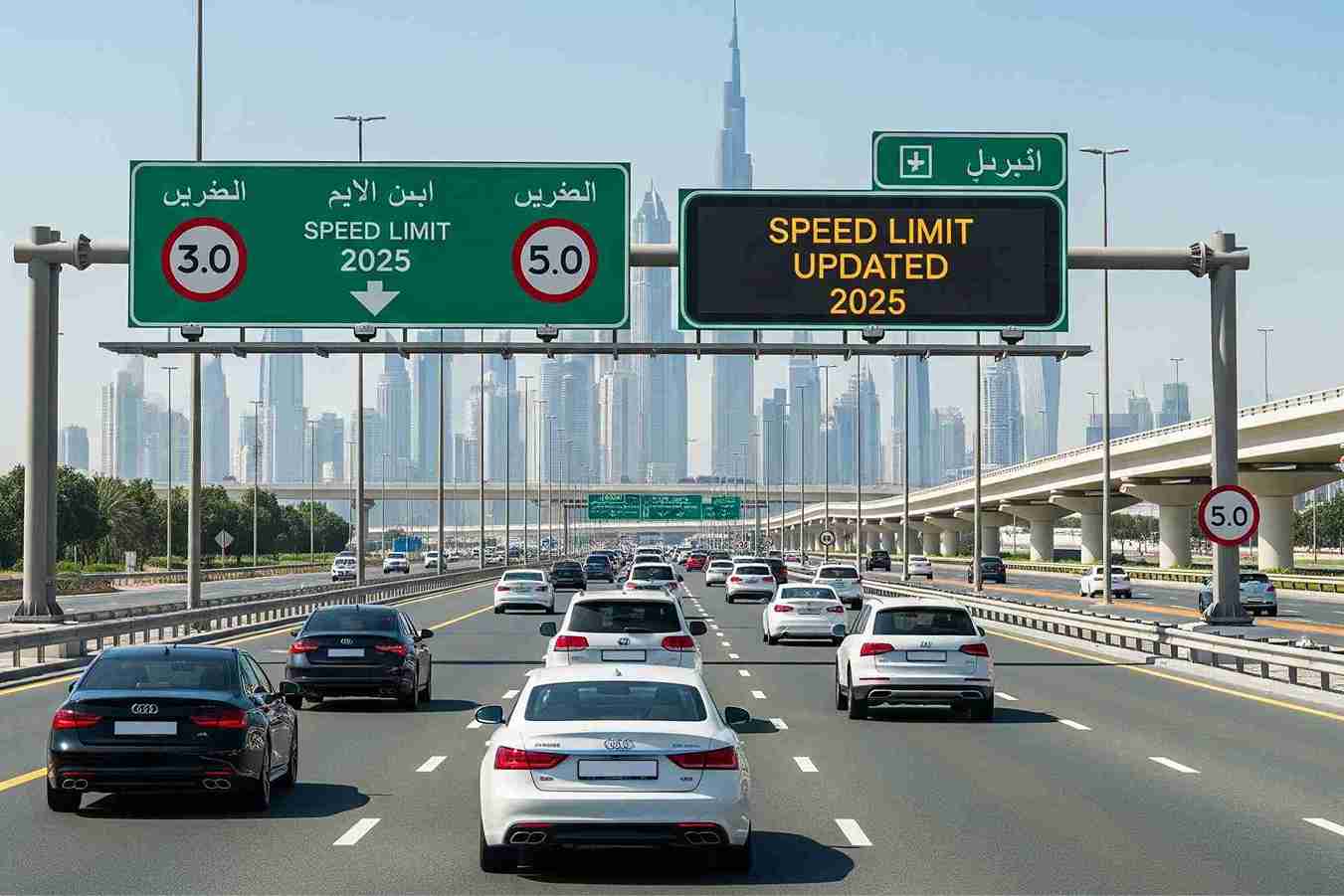
Dubai: This year, the UAE has implemented significant updates concerning speed, as police and transport authorities in Abu Dhabi, Dubai, and Ajman have launched new initiatives to enhance road safety, reduce congestion, and provide more predictable traffic conditions for drivers.
From variable speed limits to lane restrictions and revised speed rules on key highways, here is a complete guide to the latest changes.
1. Abu Dhabi introduces real-time variable speed limits
Motorists in Abu Dhabi may have noticed fluctuating speed limits on Sheikh Zayed bin Sultan Road. Since October, Abu Dhabi Mobility has activated a new variable speed limit (VSL) system, which adjusts the speed limit in real time based on weather, traffic conditions and road activity.
The digital signs on the route now show dynamic speed limits that can change throughout the day. Authorities say the system is designed to support safer driving speeds, reduce collisions and keep traffic flowing smoothly, especially on one of the capital’s busiest roads.
The displayed limit can be reduced in situations such as:
- Rain, fog or sandstorms
- Peak-hour congestion
- Major events increasing traffic volumes
- Roadworks or temporary lane closures
Drivers must follow the updated limit even if they are familiar with the usual posted speed.
2. Speed limits reduced on Sweihan Road (E20) and E11 highway
In April, Abu Dhabi also lowered limits on two major highways:
- Sweihan Road (E20): Speed reduced from 120 km/h to 100 km/h between Abu Dhabi and Sweihan
- Sheikh Khalifa bin Zayed International Road (E11): Speed limit revised from 160 km/h to 140 km/h between Abu Dhabi Industrial City and Sheikh Shakhbout Medical City
Abu Dhabi Mobility says the changes are part of ongoing efforts to minimise serious collisions and enhance safety.
In April, Abu Dhabi scrapped the 120 km/h minimum speed limit on Sheikh Mohammed bin Rashid Road (E311), the major route connecting Abu Dhabi and Dubai.
The minimum speed previously applied to the two leftmost lanes since April 2023. Authorities say removing it will help improve safety and allow smoother movement of heavy vehicles along the motorway.
Ajman is rolling out advanced smart speed-limiter devices in all taxis and limousines, making it the first emirate to implement such technology.
The devices:
- Use GPS and a smart mapping system
- Automatically adjust a vehicle’s speed based on the limit in each zone
- Send live data to a central control centre
- Prevent speeding in real time
The initiative aims to reduce risky driving, improve compliance and enhance passenger safety as part of Ajman’s wider transport-safety strategy.
5. New Dubai rule bans delivery bikes from left lanes
Dubai’s RTA and Dubai Police are introducing new lane-use rules for delivery riders to reduce accidents and improve traffic discipline.
Under the new regulations:
- On roads with five lanes or more, delivery bikes are banned from the two leftmost lanes
- On roads with three or four lanes, they must avoid the leftmost lane
- On roads with two lanes or fewer, there are no restrictions
Penalties for violations
- First offence: Dh500
- Second offence: Dh700
- Third offence: permit suspension
Riders speeding at 100 km/h or above on roads with a 100 km/h limit will also face increased fines ranging from Dh200 to Dh400.
6. Dubai highway speeds rise after truck-movement restrictions
New restrictions on truck movement are helping increase average speeds on major Dubai corridors. Since January 2025, trucks have been restricted on Emirates Road – between Al Awir Road and the Sharjah direction, during peak evening hours (5:30pm to 8pm).
RTA reported several improvements since the change:
- Traffic incidents on Emirates Road dropped from 75 in 2024 to 37 in 2025
- Truck compliance improved by 7.7% on Emirates Road and 5% on Sheikh Mohammed bin Zayed Road
- Average speeds increased by 26 km/h on Emirates Road
- Average speeds increased by 19 km/h on Sheikh Mohammed bin Zayed Road
Authorities say the restriction is part of a broader plan to improve safety and reduce congestion on key routes.