
By Desmond Nleya
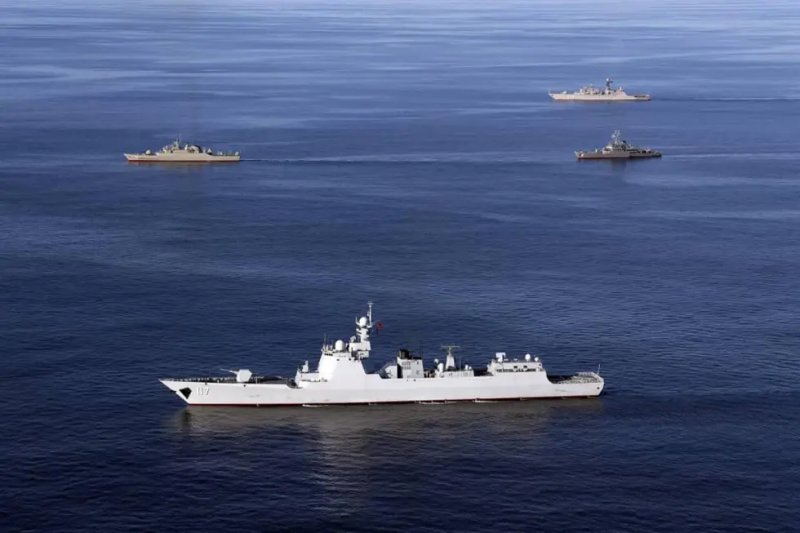
Russia, China and Iran have launched joint naval exercises in the strategic Strait of Hormuz under the “Maritime Security Belt 2026” framework, in a move analysts describe as a calculated show of force amid escalating US-Iran tensions.
The drills come as Washington intensifies military deployments across the Middle East and signals it is prepared to strike Iranian targets if nuclear negotiations fail.
Strategic Waterway Under Focus
The exercises are taking place near the Strait of Hormuz — one of the world’s most critical maritime chokepoints — linking the Persian Gulf to the Gulf of Oman and the Arabian Sea. Roughly a fifth of global oil shipments pass through the narrow corridor.
According to Russian and Iranian state media, the Russian Steregushchiy-class corvette Stoikiy has docked at Iran’s Bandar Abbas naval base ahead of coordinated drills with Iran’s navy. Chinese naval participation has also been reported, though operational details remain limited.
The drills are expected to extend into the Gulf of Oman and the northern Indian Ocean.
Tehran says the exercises are aimed at strengthening maritime security and deepening military cooperation. However, geopolitical analysts view the timing as significant.
A geopolitics think tank described the move as a “surprise,” noting it coincides with heightened US naval deployments in the region.
Iran Issues Airspace Warning
Iran has reportedly issued active Notices to Airmen (NOTAMs), warning pilots of potential hazards linked to missile and drone activity.
Open-source monitoring accounts indicated multiple gunfire zones in northwestern Iran, UAV activity near Tehran, and possible missile testing trajectories toward the Gulf of Oman.
If confirmed, the activity could signal preparations for advanced anti-ship ballistic missile tests — capabilities that directly threaten naval vessels operating in the Strait of Hormuz.
Such tests would serve both as deterrence messaging and as operational rehearsal in case of conflict.
US “Prepared” for Potential Strike
Meanwhile, US media reports suggest the American military is prepared to conduct strikes on Iranian targets as early as this weekend, pending authorization from US President Donald Trump.
According to CNN and The Wall Street Journal, Pentagon officials have presented the White House with multiple strike options — ranging from limited attacks on nuclear and missile facilities to broader operations targeting Iran’s regional military infrastructure.
The The New York Times reported that Trump is weighing competing advice: some advisers advocate decisive action to restore deterrence, while others warn of a potential regional war involving proxy militias and possibly Israel.
Carrier Strike Group Movement
The possible arrival of the USS Gerald R. Ford carrier strike group in the region marks a significant escalation in military posture. The vessel is the most advanced aircraft carrier in the US fleet.
Additional US Air Force assets, including refueling tankers and fighter aircraft based in the United Kingdom, are reportedly being repositioned closer to the Middle East.
Despite the buildup, the White House maintains that diplomacy remains the preferred course of action.
Khamenei’s Warning
Iran’s Supreme Leader Ali Khamenei responded sharply to US threats, warning that even the “strongest military force in the world” could be struck hard.
He referenced American naval deployments near Iran, suggesting US warships operating in regional waters could be vulnerable — rhetoric analysts interpret as both deterrent signaling and domestic political messaging.
A Volatile Moment
The convergence of joint Russian-Chinese-Iranian naval drills, Iranian missile activity, and US strike preparations has created one of the most volatile moments in the region in recent years.
With indirect nuclear talks reportedly ongoing in Switzerland, the situation presents a high-stakes balancing act: Washington signals readiness to act, Tehran demonstrates military capability, and Moscow and Beijing reinforce strategic alignment with Iran.