
By Staff Reporter
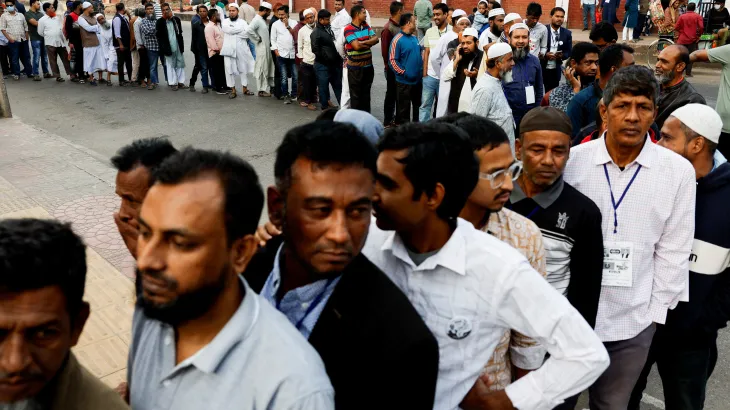
Voters queued outside polling stations across Bangladesh early Thursday as the country began voting in its 13th general election, held under heightened security nationwide.
Nearly 127 million registered voters are eligible to cast ballots in what is widely seen as a defining moment for Bangladesh’s democratic future. The election marks the first national vote since a student-led uprising in August 2024 forced longtime Prime Minister Sheikh Hasina from power.
The race is primarily a direct contest between the Bangladesh Nationalist Party (BNP) and an 11-party coalition led by Jamaat-e-Islami, which includes the newly formed National Citizens Party (NCP). The NCP was established by youth activists who played a pivotal role in last year’s political upheaval.
Authorities deployed heavy security across major cities, including Dhaka and Chattogram, as well as in rural districts, to ensure a peaceful vote. Long lines were visible at polling centers shortly after they opened, with voters expressing cautious optimism about the country’s political transition.
Key Issues Driving the Vote
Several pressing concerns are shaping voter decisions:
-
Corruption and demands for stronger institutional accountability
-
Inflation and rising living costs, which have strained household incomes
-
Unemployment, particularly among young people
-
Economic growth and stability, following months of political uncertainty
In addition to electing members of parliament, voters are also participating in a national referendum on the proposed “National Charter 2025.” The charter, drafted by the interim government led by Nobel laureate Muhammad Yunus, aims to establish a new governance framework and reform agenda for the country’s future.
Political analysts say the outcome of both the parliamentary race and the referendum will significantly shape Bangladesh’s democratic trajectory and economic direction in the years ahead.
Results are expected to begin emerging later in the day as counting gets underway.